Complete Bandaging Guide: Protection and Performance
Bandaging is not a simple pre-training ritual: it's your health insurance in the ring. Proper bandaging is essential for safeguarding the wrist joint, protecting the metacarpals, and padding the back of the hand before putting on gloves.
Furthermore, the bandage plays a crucial hygienic role: it absorbs sweat, preventing it from soaking into the glove's internal padding, thus extending its lifespan.
1. Which bandage to choose? (Length)
Not all hands are the same, and not all gloves have the same internal space. Leone1947 offers three main sizes to meet the needs of every fighter:
2.5-meter handwraps (Junior)
These are perfect for children's hands, for kids and young students who have small hands and need less fabric.
3.5-meter handwraps (Standard)
The "go-to" size for most amateurs and practitioners. They allow for proper bandaging around the wrist and knuckles without creating excessive bulk inside the glove.
4.5-meter handwraps (Pro / Sparring)
Excellent for more experienced individuals, for those with large hands, or for those who frequently engage in intense sparring. This extra length allows for many more wraps ("layering") around the hand to create substantial padding and rock-solid wrist support.
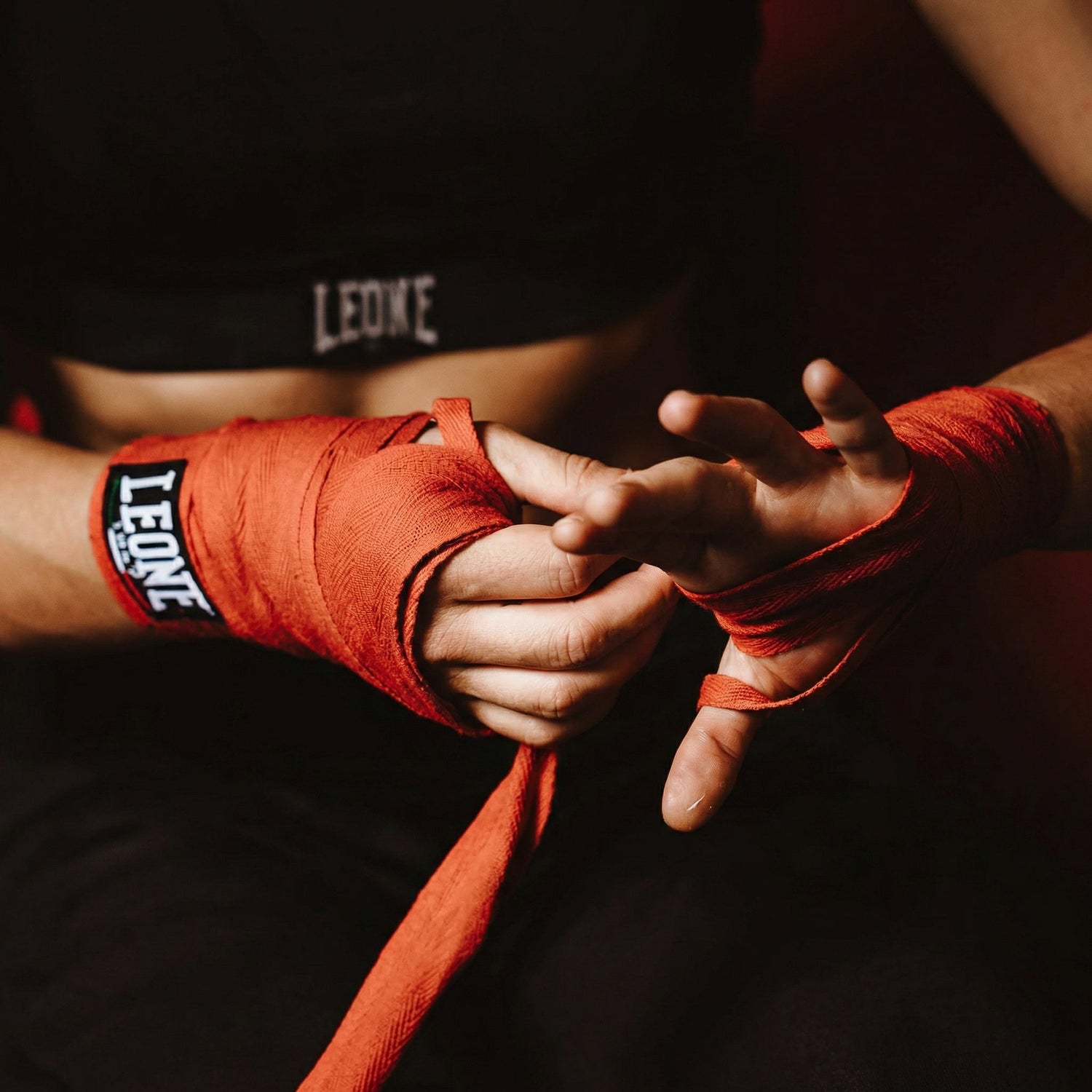
2. How to wrap your hand (Quick Tutorial)
There are dozens of techniques (from Mexican to traditional), but to start, here's the fundamental procedure to protect yourself properly:
- The initial loop: Each wrap has a small loop at the end. Slip it over your thumb. Caution: make sure the "This side down" text faces your skin.
- The wrist (The base): Proceed by wrapping the wrist 3-4 times. This is the "support" that prevents sprains.
- The knuckles (The shield): Pass over the back of the hand and wrap the knuckles. Tip: clench your fist occasionally to ensure it's not too tight.
- Between the fingers (Stability): Pass the wrap between each finger (excluding the thumb for now), crossing over the back of the hand. This prevents the wrap from slipping during punches.
- Thumb lock: Wrap the thumb to prevent chafing.
- Closure: Return to the wrist for the final wraps and secure everything with velcro.

3. Alternatives: Quick Undergloves
Short on time or doing Fitboxe? There are alternatives to traditional bandaging, useful because they are very quick to put on (5 seconds versus 5 minutes).
Classic Undergloves (AB711)
A basic elasticated underglove, featuring gel protection for the knuckles and a small integrated semi-elastic bandage to reinforce the wrists. It is an excellent "hybrid" alternative to classic handwraps.
Gel Undergloves (AB710)
The evolution of protection. "Gel undergloves" can replace traditional handwraps in fitness or bag training. Elasticated and with a special gel padding on the knuckles, they guarantee superior shock absorption.
4. The Professional Alternative (PR300)
When the going gets tough, bandaging becomes an art. Leone1947 offers a professional kit developed in collaboration with Federico Catizone, president of the International Cutman Association.
The goal of PR300 is to ensure "match protection": medical-grade components (tape and gauze) for maximum support and safety, allowing the fighter to unleash full power without fear.
FAQ – Frequently Asked Questions
Cotton wraps are rigid and durable, ideal for those who want zero elasticity. "Semi-elastic" ones (Mexican style), the most commonly used today, offer a more snug and comfortable fit that conforms to the hand's shape.
Ideally after every workout. Wraps absorb liters of sweat: washing them prevents bad odors and bacteria. Tip: use a laundry bag to prevent them from tangling in the washing machine.
You've wrapped too tightly. A correct bandage should be firm when you clench your fist, but relaxed when your hand is open. If you feel tingling or your fingers turn purplish, unwrap and start again immediately.
For light sparring, they might be fine, but for intense sessions, nothing beats a well-done traditional handwrap (4.5m), which locks the wrist joint much more solidly than an underglove.
Other Recommended Guides
Boxing shoes: a guide to choosing the best for top performance
Read GuideHow to choose the perfect boxing gloves
Read GuideWhen is it time to change your boxing gloves?
Read GuideHow to clean your boxing gloves and eliminate odors
Read GuideHow to properly wrap your hands
Read GuideComplete guide to the Leone1947 boxing bag
Read GuideHow to choose your Coach equipment
Read GuideGift ideas for combat sports enthusiasts
Read Guide